

By Sunil Erevelles, PhD
UNC Charlotte Professor and former Chair of the Department of Marketing at the Belk College of Business
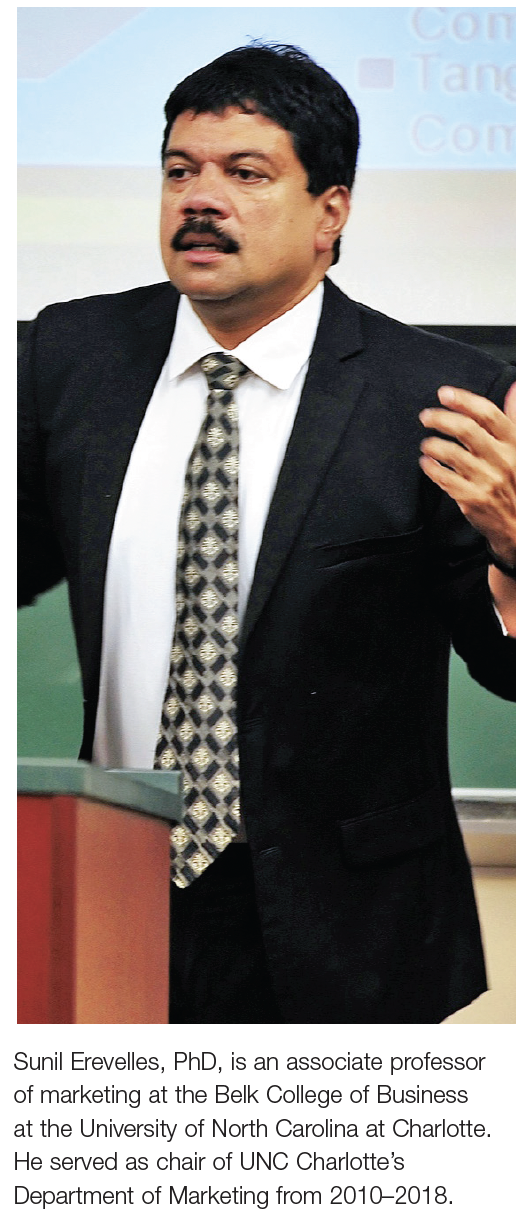
Most people and businesses currently use generative AI as a tool while they work to understand its transformative potential. According to Dr. Sunil Erevelles, this perspective may be too limited. He argues that generative AI is not simply a tool but a technology with increasing agency—the ability to think, act, and make decisions autonomously. While using AI as a tool may be an effective short-term strategy, Erevelles believes people should recognize that as AI learns more about individuals through ongoing interaction, it may evolve from a simple assistant into a far more influential force. This reality, he argues, makes safeguards, public policy, and responsible oversight essential.
Generative AI is already transforming daily life across numerous industries. In banking, AI functions as a virtual financial assistant, helping customers execute transactions, monitor spending, reset passwords, obtain credit information, and receive financial guidance. Financial institutions also use AI internally for credit-risk analysis, fraud detection, delinquency forecasting, stress testing, and loss prediction. Erevelles points to Bank of America’s multibillion-dollar investment in technology initiatives as evidence of the growing importance of AI within the financial sector.
Healthcare is another field experiencing dramatic change through AI adoption. Physicians increasingly use AI to convert patient conversations into clinical notes, recommend laboratory tests, generate billing codes, and support prescription decisions. AI-powered diagnostic tools are also improving medical imaging and disease detection.
Erevelles cites examples in colonoscopy procedures, where AI systems trained on millions of cases have demonstrated an ability to identify abnormalities with greater consistency than human practitioners. Beyond diagnostics, healthcare organizations use AI to streamline scheduling, billing, and administrative tasks, improving operational efficiency.
Government agencies are also integrating AI into their operations. The Internal Revenue Service, for example, uses AI to assist with fraud detection, tax compliance monitoring, and customer-service functions. In law enforcement, AI helps forecast crime trends, identify high-risk areas, evaluate potential biases, and analyze incident reports. Erevelles suggests that democracies may benefit from publicly available AI systems capable of reviewing legislation, ensuring constitutional compliance, promoting transparency, and helping policymakers identify ethical concerns before laws are enacted.

The fashion industry has embraced AI in both creative and operational capacities. AI-generated models and virtual influencers are increasingly appearing in advertising campaigns, social media content, and marketing materials. Some companies are using AI to create digital versions of models, while others employ AI to predict emerging fashion trends, generate new designs, and optimize products for production costs and consumer demand. These developments have sparked debate about authenticity, creativity, and the ethical implications of digitally replicating human likenesses.
Looking toward the future, Erevelles believes generative AI has the potential to usher in an era of abundance by dramatically reducing the cost of producing goods and services. However, he also warns that the technology presents significant risks if left unchecked. He argues that AI differs from previous technological innovations because it is capable of creating, deciding, and executing actions with increasing independence. Unlike earlier inventions that expanded human power, Erevelles believes generative AI may gradually shift power away from humans, requiring leaders and organizations to rethink traditional approaches to decision-making, values, and management.
One of the most significant long-term effects of AI may be its impact on employment and human intelligence. Historically, machines replaced physical labor, pushing workers toward more advanced physical or intellectual roles. Today, AI is increasingly performing intellectual tasks once thought to be uniquely human. Jobs centered on routine information processing, analysis, coding, and even certain forms of diagnosis are becoming more susceptible to automation. Erevelles argues that this shift will require society to focus more heavily on uniquely human capabilities such as imagination, creativity, emotional intelligence, innovation, and consciousness.
Perhaps the most profound transformation, according to Erevelles, is AI’s ability to understand people at a deeper level than traditional data systems ever could. While conventional data analysis focuses largely on external behaviors, generative AI can capture and interpret emotions, motivations, preferences, and patterns of thought. This capability allows AI to predict choices, influence decisions, and personalize experiences with remarkable precision. As a result, marketing and business strategy may shift from merely capturing consumer attention to developing deeper forms of engagement and intimacy.
Erevelles concludes that society is witnessing the emergence of what he calls a hyperintelligent “superspecies.” In his view, AI is already demonstrating capabilities that exceed human performance in many areas and will continue to reshape business, government, healthcare, education, and everyday life. Whether this transformation ultimately benefits humanity will depend largely on how effectively people establish ethical frameworks, public policy, and safeguards to guide its development.