

By Derik Hicks
Charlotte has long been known as one of the fastest-growing cities in the Southeast. Now, recent data from LendingTree shows the city is also becoming a significant hub for Black entrepreneurship.
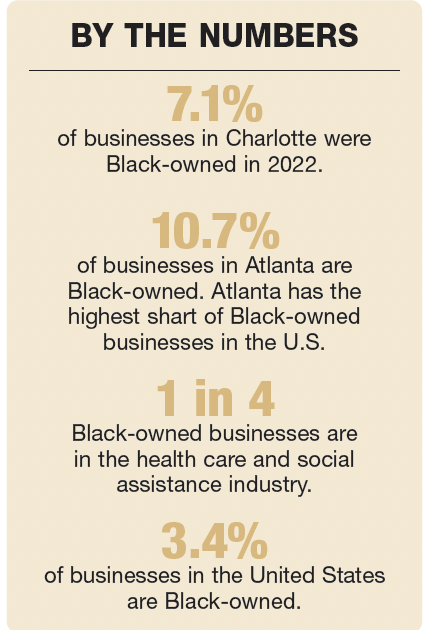
According to LendingTree’s 2023 study analyzing data from the U.S. Census Bureau, Charlotte is ranked 16th among the 50 largest U.S. metro areas for the percentage of Black-owned businesses. In 2023, 6.5 percent of businesses in the Charlotte metro area were Black-owned, a figure that remains well above the national average.
The ranking reflects several years of growth. In 2021, Black-owned businesses accounted for 5.3 percent of businesses in the Charlotte metro area. That figure rose to 7.1 percent in 2022 before settling at 6.5 percent in 2023.
Researchers with LendingTree analyzed 2023 data from the Census Bureau’s Annual Business Survey to determine which metro areas have the highest percentage of Black-owned businesses. The methodology involved compiling the number of Black-owned businesses in the 100 metros with the largest totals and comparing those figures with the total number of businesses in each area. The metros were then ranked based on the percentage of Black-owned firms.
For the 4th year in a row, Atlanta has the highest share of Black-owned businesses at 10.7 percent. Fayetteville, N.C. with 9.9%, and Washington, D.C. at 9.4%), rank second and third, respectively.
The LendingTree study found that about 1 in 4 Black-owned businesses are in the health care and social assistance industry, with 26.2% of Black-owned businesses involved in this industry in 2023 — up from 25.6% in 2022. The Black-owned business with the next highest percentages are scientific and technical services at 14%, and administrative and support and waste management and remediation services at 8.1%.
Although only 3.4% of businesses in the U.S. are Black-owned, the percentage of Black-owned businesses in the country has increased in recent years. In 2020, 2.4% of the country’s companies were Black-owned, with that percentage rising to 2.7% in 2021 and 3.3% in 2022, the study shows.
“The persistent low share of Black-owned businesses partly reflects ongoing structural barriers that many entrepreneurs of color face,” according to the study. “Research indicates that access to funding remains a central challenge: Black founders are more likely to rely on personal savings or high-interest credit because of loan-denial disparities and lower intergenerational wealth than their white counterparts.”
“Black-owned businesses make up a relatively small share of businesses nationally, but certain metro areas stand out for their higher representation,” the report notes. Charlotte is among those cities. The ranking reflects both the region’s demographic diversity and its expanding economy.
A City Built on Growth
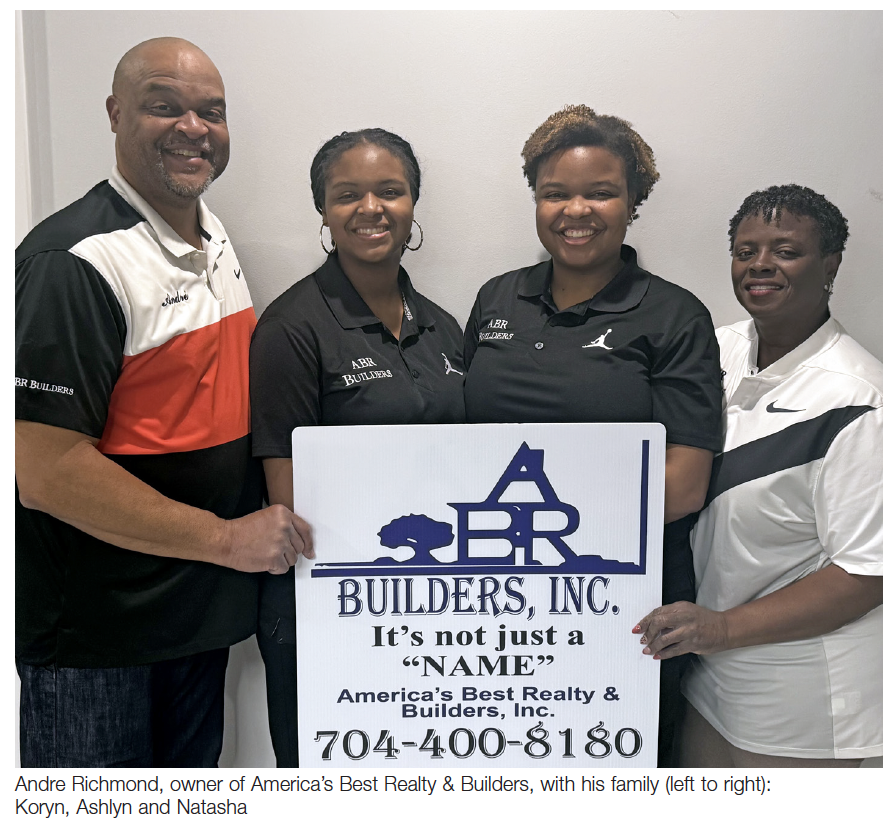
For many Charlotte-area entrepreneurs, the numbers reflect what they have experienced firsthand. Andre Richmond, owner of America’s Best Realty & Builders, has spent nearly three decades building his business. A licensed real estate broker since 1995 and a licensed general contractor since 1997, Richmond runs a full-service company that handles real estate transactions, remodeling, additions and new construction projects.
Born and raised in Charlotte, Richmond watched the city transform from a regional hub into one of the country’s most dynamic metro areas. “My family owned a small business in Charlotte,” he said. “I knew I wanted to run my own business, but when I was younger, I just didn’t know what type of business it would be.”
While working full time after high school, Richmond attended trade school at night to study real estate and construction. In 1995, he began working part-time as a real estate agent while building a client base. After earning his general contractor’s license in 1997, Richmond worked in both fields part time before launching his business full-time in 1999.
Opportunity and responsibility
Despite the challenges that come from the Queen City’s changing landscape and diversity, Richmond credits Charlotte’s strong corporate presence and local networks for helping entrepreneurs gain experience and build relationships.
“Sometimes you have to link up with some of those companies to get the proper training and experience as a subcontractor while still owning your own business,” he said. “For me, community support is very important,” Richmond said. “Ninety-five percent of my work comes from referrals within the community. The key is to do a very good job the first time.”
Still, Richmond said challenges remain for many Black entrepreneurs, particularly with financing and overcoming stereotypes. “Starting off, it was very difficult to secure funds,” he said. “I had to use my car or house as collateral to get a loan.”
Building the next generation
The growth of Black-owned businesses in Charlotte represents more than economic progress. According to Richmond, it represents a legacy. “Charlotte has a large Black population and is still growing. We have to leave an example for the next generation. The city can flourish when all cultures and races are doing well.” As Charlotte continues to attract new residents and investment, the city’s entrepreneurial landscape is likely to grow further. If the trends identified by LendingTree continue, Charlotte’s Black entrepreneurs may play an increasingly important role in shaping the city’s economic future — one business at a time