
When astronauts Neil Armstong and Buzz Aldrin journeyed into space and became the first astronauts to walk on the moon in 1969, they inspired the young Bernard A. Harris Jr. to literally “reach for the stars.”
“At 13, I watched Neil Armstrong and Buzz Aldrin land on the moon and inspire the whole world with the notion that the human race could travel to another heavenly body,” Harris said. “That was the foundation of my desire to become an explorer of space.”
Then and there, Harris adopted unwavering confidence that despite the world he lived in and the color of his skin, he could, indeed, make a grab for the stars. “Even though I didn’t see anyone who looked like me in the space program, I wasn’t going to let that deter me,” he said.
Harris was born to Bernard Senior and Gussie Emanuel Harris in Temple, Texas in 1956. Harris Senior was a military man from Philadelphia and Gussie was an East Texas native. Together they had three children. But their marriage was short-lived.
Faced with raising three children on her own, Harris’ mother determined that poor, inner city Houston was not the place she wanted them to grow up. But Gussie had a safety net – she had a college degree. “[This is when] I learned one of my first big lessons — the importance of education,” said Harris.
“Education gave her options. And she exercised those options. And that was to get her children out of that environment,” he said.
At a time when few Black women completed high school, Harris’ mother graduated from Prairie View University, the oldest HBCU in Texas, with a teaching degree prior to beginning family life. Harris said his maternal family’s emphasis on education began even generations before his mother.
“Education was instilled in all of us,” Harris said. “There was no choice. It wasn’t ‘Are you going to college?’ or ‘If you’re going to college?’”
After his mother accepted a job teaching third grade for the Navajo Nation, the family relocated from Texas to the largest Native American reservation in the Four Corners region of the American Southwest.
He said spending his formative years living in the vast and colorful expanse of the Southwest broadened his scope. “It allowed me to be in a place where I could dream and visualize myself becoming the man I am today. When you are out in the middle of nowhere and you look up in the heavens, you don’t need a telescope,” he said.
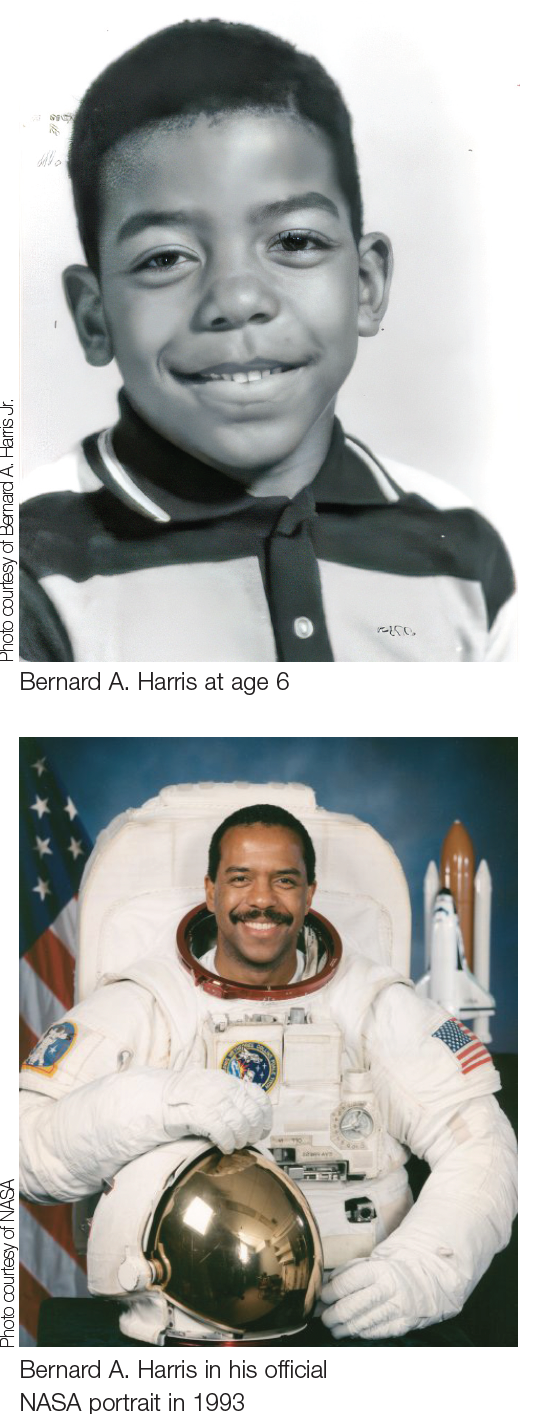
“As I was stargazing, I was also looking at the little black and white television… watching the space program [unfold],” Harris said. “Imagine being able to look at the heavens and see the Milky Way Galaxy and at the same time see human beings doing something that had never been done before. I wanted to follow in their footsteps.”
Despite his ambitions, Harris was aware of the realities surrounding him. “I watched the Civil Rights Movement on the same little black and white TV,” he said. He was profoundly impacted by both the great strides being made by his people and systemic racism facing them,” he added.
“Many would say, ‘As a black person during that time, why would you conceive that you could even be an astronaut?’” He said it was in part because of “that strong family history and spiritual history that taught me I could be and do anything I wanted to be.” Harris credits his mother with “enabling his dream.”
After the family moved to San Antonio, Texas when Harris was 15, he wrote to NASA expressing interest in becoming an astronaut. NASA responded with a letter detailing the requisites.
“I realized I needed to find some kind of specialty or field. I couldn’t just become an astronaut and go to space,” Harris said. So, he decided to study medicine, blending his love of science with a deep desire to help the greater good.
“I thought becoming an astronaut, particularly being Black and becoming an astronaut, was like being struck by lightning. So, I always had a backup plan. If I don’t go to space, I’ll still be in a profession that is very valuable here on earth,” he said.
With the help of student loans, his parent’s savings and work study programs, Harris graduated from the University of Houston with a bachelor’s degree in biology in 1978, followed by four years at Texas Tech University Health Science Center of Medicine where he earned his medical degree in 1982.
During his residency at the Mayo Clinic, Harris learned another important lesson.

“I consider it divine intervention that my very first professor [at Mayo] was a doctor on the ships that picked up astronauts after landings,” Harris said, adding that his professor offered him invaluable insight and direction on his journey. “I learned the value of mentors and supporters.”
Despite his driving ambition and laser focus on his goals, Harris still experienced moments of self doubt and discouragement.
“Nobody came to me directly and said, ‘You can’t do that’” he said. “But [the message] comes in the form of the stereotypes you see on television. It comes in the form of not seeing anybody [who looks like me] doing it.”
A particularly difficult setback came in 1987, when Harris’ first application to enter the NASA Astronaut Corp was denied. He wasted little time on self-pity. “I brushed off the disappointment and tried again,” said Harris. “Keeping in mind the destination.”
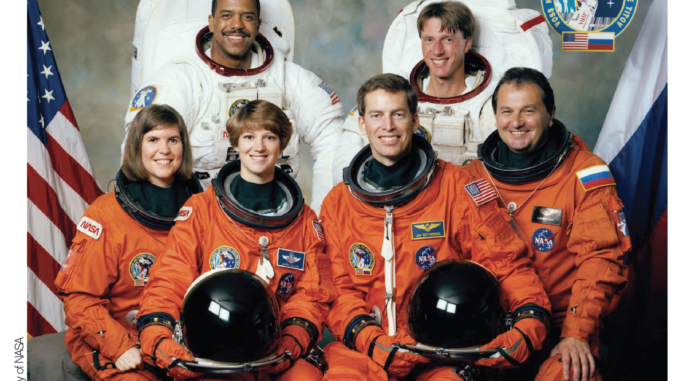
After a successful second attempt, Harris was accepted into the next class. In 1993, Harris’ lifelong dream reached fruition when he was selected to serve as mission specialist on the Columbia Space Shuttle STS-55 mission.
“Blasting off in space is not the safest thing to do,” said Harris. He admits his excitement outweighed his fears. “I felt incredibly blessed.”
Less than two years later, the blessings continued. During a mission on Discovery STS-63, Harris completed a spacewalk, becoming the first African American to do so. Connected to the spacecraft by a tether, Harris and another crewmate spent over four hours conducting experiments outside of the shuttle. Here — floating in open space, no longer beneath the stars, but among them — is when Harris’ journey came full circle.
At just 39, the boyhood stargazer had become a space pioneer.
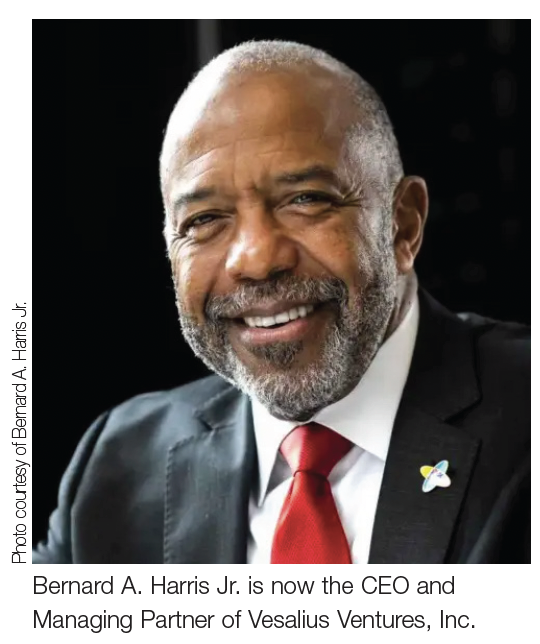
Despite his achievements, Harris was hardly finished when he left NASA in 1996. In addition to a successful career helping to develop and promote telemedicine via his venture capital firm Vesalius Ventures, Inc., Harris is dedicated to paying it forward.
“I’ve been blessed to accomplish a lot. Now my focus is in helping others reach their full potential,” he said. “That’s my mission and my passion.” Through various endeavors and the creation of The Harris Institute, Harris has successfully encouraged young people nationwide who are “underserved and underrepresented” to keep looking up.
“If you look at my background [you might say], ‘Would this guy become an astronaut?’ No! Broken home, struggling Black family… How in the world did that happen?’ I’m an example of what you can do if you don’t let your external environment dictate who you are,” he said.
Harris knows well that while most dreams are born in private, seeing them through requires outside support. “Sometimes what you need is for someone to tell you that despite your beginnings, despite the color of your skin, despite your sex… you can be and do anything that you want,” he said.
In 2025 Harris published “Embracing Infinite Possibilities: Letting Go of Fear to Find Your Highest Potential.” In the book, he encourages “stargazers” of all kinds to maintain that same zeal and ambition in charting their own course. “Never give up on your dreams! Be assured that you are an infinite being with infinite possibilities.”